Introduction
companies relying on digital services, building reliability intelligence and resilience are must haves in order to protect the bottom line. By leveraging reliability intelligence the real-time insight into system performance, dependencies, and potential points of failure organizations can proactively identify issues before they impact customers. When the digital experience starts to falter whether that’s a slow checkout, a VPN that’s not working as it should, or a SaaS partner that’s stuttering customers feel the pain directly and often clear out, no matter where the failure was. Reliability intelligence enables businesses to detect, diagnose, and resolve these disruptions faster, ensuring consistent performance and safeguarding customer trust.
Because of this, operational resilience has shot up to the top of the boardroom agenda. Gartner says that operational resilience goes way beyond just “keeping the lights on” – it’s about understanding those all-important dependencies, assessing how well you can weather a disruption and most importantly managing the impact on your stakeholders. At the same time, while you might not be seeing as many outright outages as you used to, industry research like what the Uptime Institute is finding shows just how costly and serious the consequences can be.
In other words, the reality is most companies are trying to achieve business resilience using tools that are just not up to the job tools that were designed for the old days when a single NOC dashboard and a few key performance indicators were all you needed to get by.
Fragmented Observability: The Unseen Threat to Business Resilience
The reality facing IT and business leaders today
Most mid-to-large enterprises are relying on:
- A whole bunch of separate tools for different bits of the infrastructure and application stack
- Vendor-specific dashboards that don’t play nicely with each other
- Thousands of alerts with no clear priority on them
- Metrics that make sense to engineers but make no sense to executives.
As a result, you’ve got:
- Mean Time To Resolution (MTTR) that’s still way too long
- Reliability investments that are a case of “we fix this when it breaks”, rather than a thoughtful, proactive strategy
- Business leaders who are in the dark when it comes to the risks they’re taking on the operational side.
This disconnect, in turn, makes it a real challenge to get reliability right across all those different environments – whether that’s mainframes and on-prem systems or cloud-native applications and SD-WAN networks.
Ultimately, Without a unified reliability view, you’re stuck in the dark.
Learn how to unify metrics, predict downtime, and measure business resilience in hybrid and multi-cloud environments.
What Is Reliability Intelligence and Why Does It Matter?
Reliability intelligence is where observability goes next because it’s about turning raw data into real decision intelligence.
Rather than asking your teams to pore over raw metrics and try to make sense of them on their own, reliability intelligence:
- Takes all those different signals and condenses them down into a single, standardised reliability score
- Uses statistical models and AI to spot patterns and predict where things might go wrong
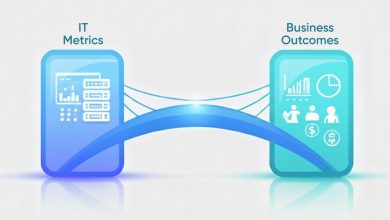
- Aligns technical performance with the real business risk and impact
At its heart, reliability intelligence gives you three really important answers:
- How reliable is our business right now?
- What’s causing performance to tick down and why?
- What are we going to do next to actually make reliability better?
That’s exactly why Scout-itAI was designed to answer those questions at scale.
The Reliability Path Index (RPI Score): Translating Metrics into Meaning
One of the biggest challenges in building business resilience is getting everyone in the business talking about reliability in the same way.
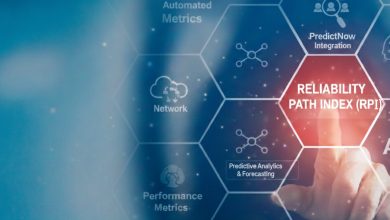
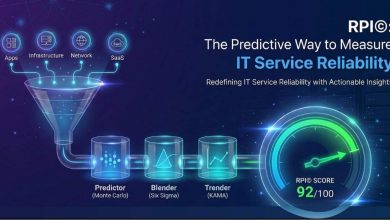
To solve that, Scout-itAI uses its patented Reliability Path Index (RPI) a unified scoring framework that takes all that complexity and turns it into clear, actionable information.
So how does RPI work?
- It takes all those thousand plus metrics and condenses them down into 13 reliability buckets
- It uses 15+ years of industry data to drive the insights
- It generates a single, standardized reliability score across all the important areas-
including:
- Apps
- Infrastructure
- Networks
- Hybrid and multi-cloud environments
Why does this matter for resilience?
Put simply:
- IT leaders get a consistent way to measure reliability
- Business stakeholders get a view of reliability that doesn’t require a deep understanding of the tech
- Executives can track reliability improvements over time
And as a result, resilience becomes a core part of business decision-making.
👉 Find out more about unified reliability scoring on the Scout-itAI Platform.
Reliability Forecasting: Anticipating and Preventing Downtime
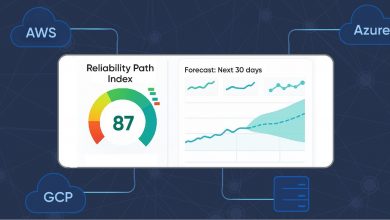
Next, we need to get way beyond reactive monitoring if we’re going to build a business that’s seriously resilient. That’s where Scout-itAI’s Predictor comes in, using Monte Carlo forecasting to simulate a wide range of scenarios, such as:
- What will happen to reliability if we increase traffic by 30%?
- Will migrating that app improve or degrade performance?
- Which investment delivers the highest reliability return on investment?
The Business Benefits of Predictive Reliability Intelligence
- Data-driven infrastructure and cloud planning
- Risk-aware change management
- Confidence in digital transformation initiatives
In short, Rather than just reacting to outages, organizations can actually design resilience into their processes from the start.
Statistical Intelligence at Scale: Increasing Signal, Reducing Noise
Alert fatigue is a major obstacle to achieving operational resilience. Fortunately, Scout-itAI’s Blender engine directly addresses this challenge using real-time Six Sigma statistical analysis. Specifically, it allows you to:
- Spot performance-impacting patterns across alarms and metrics
- Identify where to focus your efforts to actually improve reliability
- Correlate signals across different domains which is important because traditional tools often miss these relationships
- Kill off unnecessary and repetitive alerts
On top of that, by integrating adaptive trend analysis (known as KAMA), Scout-itAI is able to:
- Compare current performance against a rolling 100-day baseline
- Recognise early warning signs of degradation before it’s too late
- Proactively flag anomalies that could become major outages
The result? A more reliable system, fewer alerts, faster diagnosis, and a genuinely resilient operation.
Agentic AI: Taking Observability to the Next Level
Organizations are no longer looking for simple AI chatbots; instead, they’re on the hunt for AI that can operate on its own continuously and with transparency.
To meet that need, Scout-itAI uses an agentic AI framework with orchestrators and sub-agents to boost reliability by:
- Looking at issues across a wide range of telemetry sources
- Automatically producing concrete recommendations to improve performance
- Only pushing through critical, actionable alerts while ignoring the noise
As a result, you get a massive reduction in Mean Time to Resolution (MTTR) with far less constant human intervention.
However and this is a big however Scout-itAI is built with strict governance controls designed to:
- Stop that unpredictable AI drift.
- Minimise the risk of the AI making up things (hallucinations)
- Ensure insights are verifiable and fully actionable
Taken together, this means Scout-itAI isn’t just another monitoring tool it’s a strategic reliability partner.
Business Context: The Essential Element of Observability
Resilience isn’t just about uptime it’s about impact. That’s why Scout-itAI translates telemetry into plain-language insights that answer:
- What’s going wrong?
- Where’s it going wrong?
- How is it impacting customers, revenue, or productivity?
Which allows for:
- Transparency in reporting to CEOs and executives
- Stronger collaboration between IT and business teams
- Reliability conversations that are really rooted in outcomes, not metrics
For CIOs, CDOs and Digital leaders, this is business critical to their enterprise resilience strategy.
Unified Visibility Across Hybrid and Multi-Cloud Environments
Reliable businesses don’t operate in one single environment. Accordingly, Scout-itAI gives you:
Scout-itAI gives you:
- Universal hybrid cloud monitoring across AWS, Azure, GCP and on-prem.
- Real-time and historical visibility – up to 12 months.
- Seamless integration with tools like Splunk, Dynatrace, AppNeta and Broadcom DX NetOps/OI.
Importantly, it’s not about replacing existing investments, it’s about unifying and enhancing them through reliability and intelligence.
Find out how Scout-itAI can give you cross-domain visibility on the Scout-itAI Cloud.
Why Reliability Intelligence Is the Foundation of Business Resilience
| Traditional Monitoring | Reliability Intelligence |
| Reactive alerts | Predictive insights |
| Siloed dashboards | Unified reliability scores |
| Metric overload | Business-aligned intelligence |
| Manual troubleshooting | Agentic AI automation |
| IT-only visibility | Executive-ready insights |
Resilient organizations don’t just respond faster they also anticipate, adapt, and improve continuously. That’s exactly why reliability intelligence makes resilience achievable.
Conclusion
Business resilience is no longer a future goal, it’s a present requirement.
Organizations that continue to rely on fragmented monitoring and reactive processes will struggle to keep up with complexity, scale, and business expectations.
By contrast, Scout-itAI empowers enterprises to:
- Understand reliability in a single, standardized language
- Predict risk before it impacts the business
- Automate insight and action through agentic AI
- Align IT performance directly with business outcomes
Ultimately, reliability intelligence is how resilient businesses are built. Ready to move beyond dashboards and alerts? 👉 Book a Demo with Scout-itAI
Frequently Asked Questions
Reliability intelligence is the practice of transforming observability data into actionable insights that predict, improve, and standardize system reliability across environments.
It enables proactive risk management, faster issue resolution, and business-aligned decision-making that reduces downtime and operational disruption.
Scout-itAI unifies telemetry across domains, applies statistical modeling and agentic AI, and delivers plain-language insights tied to business impact.
RPI is a patented scoring system that condenses thousands of metrics into a single reliability score across applications, infrastructure, and networks.
Yes. Scout-itAI uses Monte Carlo forecasting to simulate how changes may impact reliability before issues occur.
No. Scout-itAI integrates with tools like Splunk and Dynatrace to unify insights rather than replace investments.
By focusing on 13 key reliability metrics and applying Six Sigma statistical analysis to eliminate noise.
IT operations leaders, network teams, CIOs, CDOs, and executives who need clear, business-aligned reliability insights.
Yes. Scout-itAI supports AWS, Azure, GCP, and on-prem systems with real-time and historical visibility.
You can start by booking a demo or exploring the platform at scoutitai.com

Tony Davis
Director of Agentic Solutions & Compliance